
Intrusion sensors
Glass Break Detector
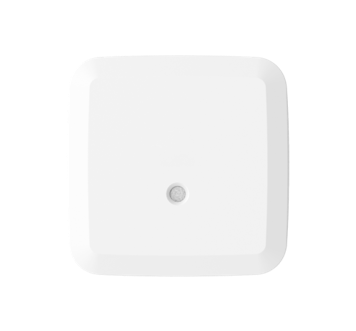
This sensor triggers an alarm when it detects the frequency of breaking glass. One sensor can protect an entire wall of windows.
60-day money-back guarantee · free shipping · no contracts
- Detects the frequency of breaking and cracking glass
- Range of up to 15 feet means this sensor can cover an entire wall of windows
- Tamper-resistant to prevent intruders from disabling
Specifications
- Dimensions
- 2.6"x2.6"x.8"
- Weight
- 3.13 oz (89 g)
- Installation
- Peel and stick adhesive
- Battery Type
- 2 AA alkaline batteries
- Wired or Wireless
- Wireless
- Smart home compatability
- Alexa and Google Assistant
- Frequency
- 345.00 MHz
- Supervisory Interval
- 70 minutes
- Operating temperature
- 32° F - 120° F
- Operating humidity
- 5-90% Non Condensing
Frequently asked questions
Both glass break sensors and window sensors are used to protect windows, but they accomplish the same goal differently. Window sensors could probably more accurately be referred to as "window opening sensors," while glass break sensors could be referred to as "window breaking sensors."
Window sensors have two pieces: one is a magnet that's placed on the window frame, and the other is a sensor that's placed directly on the window. When placed close together, the magnet and the sensor do not sound an alarm, but when a window opens and the two pieces are separated, the sensor sends an alarm to the panel. Glass break sensors work differently.
Instead of sensing the opening and closing of a window, they sense the window breaking. A glass break sensor is placed on the wall opposite a window, and it's a lot like an ear. It "hears" the frequency of breaking glass.
Yes! Glass break sensors really can sense breaking glass! As long as your sensor is directly facing your windows and is within 15 feet, the audio recognition technology inside the sensor will notify you if your window breaks. These sensors are especially useful as an extra layer of protection or for second-story windows.
If the frequency at which your dog barks matches the frequency of breaking glass, it is technically possible that this could set off a glass break sensor. This is not a common occurrence, but if it happens to you, please reach out to our customer service team at 855.268.3669. If you have a large dog, we recommend installing a glass break sensor as your second layer of protection instead of our motion sensor (which is pet-friendly up to 35-50 lbs but not suitable for larger pets).
Glass break sensors provide some extra peace of mind, right where you need it.
We suppose you could break a plate in front of your sensor, but we don't recommend that strategy. Instead, our glass break detector includes a test button, so you can ensure that your sensor is communicating with your panel at all times.
A glass break detector all by itself can do a lot of amazing things, but the security gets even better when it's connected to a professionally monitored alarm system.
There are two kinds of detectors that will trigger a breaking glass alarm: acoustic glass break sensors and vibration glass break sensors. They both have pros and cons, but they operate very differently. An acoustic sensor (like the one offered by Cove) actually "hears" the sound of breaking glass by using an audio sensing technology.
These sensors must be placed on a wall or shelf facing a window (or a wall of windows). Vibration glass breaking alarms are placed directly on the windowpane. As their name suggests, they sense vibrations in the glass window rather than the audible frequency associated with breaking glass.
Both sensors are effective, but an acoustic glass break sensor provides more coverage per sensor than a vibration sensor.
Any exceptionally loud sound that is the same frequency as that of breaking glass can trigger a glass break alarm. Some common sounds that might set off your alarm are: Thunderstorms, Sonic booms, Fireworks, Slamming doors, And yes, occasionally, a barking dog.
No, acoustic glass break detectors cannot hear through walls. The Cove glass break sensor has a range of 15 feet and must be placed directly across from the windows you are hoping to protect. If there is no wall close enough, the sensor may be placed on the ceiling.
We're so glad you asked! For additional information about setting up your glass break sensor, please visit https://support.covesmart.com/category/glass-break-detector.
Pairs well with


PRIME DAY SALE· Ends in 7 hours
Protect your home tonight.
Add Glass Break Detector to a complete system and lock in Prime Day Sale pricing - up to 70% off equipment with a free HD camera.
Build my system60-day money-back guarantee · No contracts